

“Methane Management Must Be Measurement-Based”…National Assembly Forum Discusses Methane MRV
본문
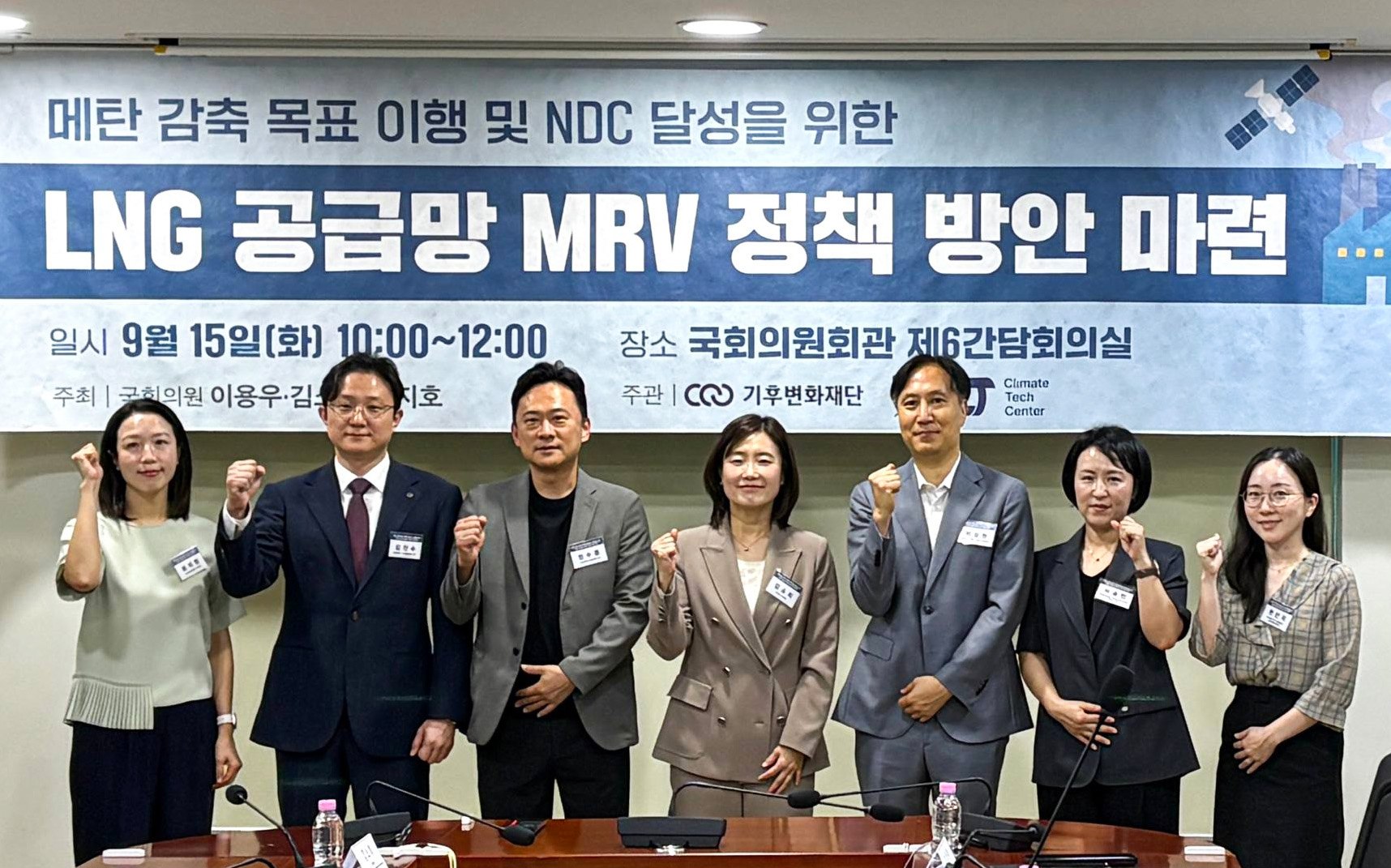
A National Assembly forum titled “Developing LNG Supply Chain MRV Policy Measures to Implement Methane Reduction Targets and Achieve NDCs” was held on September 15 at the National Assembly Members’ Office Building. The event was co-hosted by the offices of National Assembly Members Lee Yong-woo, Kim So-hee, and Cha Ji-ho, and organized by Climate Change Foundation and Seoul National University Climate Tech Center.
In her congratulatory remarks, National Assembly Member Kim So-hee said, “Although methane remains in the atmosphere for a shorter period, it has a significant greenhouse gas impact. Reducing methane leakage can therefore deliver clear emissions reduction benefits. In line with the global shift toward measurement, monitoring, reporting, and verification (MMRV), the National Assembly and government must work together to establish institutional support measures.”
Professor Chung Soo-jong of Seoul National University and Director of the Climate Tech Center presented methane leakage measurement results from domestic LNG power plants and major industrial complexes, noting that measurements revealed methane concentrations above background levels at the sites.
He emphasized the need for direct measurement to identify emission sources and connect confirmed emissions to actual reductions through leak detection and repair (LDAR). Measurement-based source management, he explained, can reduce unnecessary gas losses while contributing to corporate cost savings and national greenhouse gas reductions. “A measurement-based management system is a form of constructive regulation that can deliver both corporate cost savings and national emissions reductions,” he said.
Professor Kim Jin-soo of Hanyang University proposed a policy framework to manage methane emissions across domestic and overseas energy supply chains, taking into account Korea’s position as an energy-importing country.
“Korea can leverage its purchasing power to encourage methane reductions across energy supply chains,” Professor Kim said. “A phased policy approach is needed, including encouraging companies to manage methane based on existing safety management systems, promoting participation in OGMP 2.0, and linking methane management with the emissions trading system.” These policy directions were also included in “MRV-Based Policy Framework for Reducing Methane Emissions in Korea’s Energy Sector,” released on September 11 by Professor Kim and the Climate Change Foundation.
The panel discussion explored ways to connect MRV with industrial operations and policy instruments.
Lee Seung-min, Senior Research Fellow at the Korea Environment Institute, said, “A multi-layered measurement system using satellites, aircraft, and mobile measurements is a key foundation for establishing methane MRV. We need a system that uses measurement results to verify and improve the national greenhouse gas inventory.”
Han Min-ji, Team Leader at the Korea Legislation Research Institute, proposed integrating methane-specific MRV and reduction measures into existing legal frameworks. “Rather than establishing a new legal framework specifically for methane MRV, it would be more appropriate for Korea’s regulatory system to use the greenhouse gas reduction framework under the Framework Act on Carbon Neutrality as a common legal foundation, while adding methane-specific MRV and reduction measures to existing sectoral laws, including those governing energy,” she said.
Lee Sang-heon, Director of the Climate and Energy Policy Division at the Ministry of Climate, Energy and Environment, said, “Inter-ministerial cooperation is necessary to advance methane management policies."
Choi Ji-won, Director General of the Climate Change Foundation, emphasized the importance of a clear LNG transition pathway and supply chain transparency. “The government must clarify LNG’s transition pathway and ensure rigorous methane management during the period in which LNG remains necessary in the energy transition, while developing supply chain transparency into a new source of competitiveness in the international LNG market,” she said.
Moon Kwang-joo, Research Officer at the National Institute of Environmental Research, said, “A month-long detailed field investigation of two LNG power generation facilities confirmed that the latest sensor technologies can sufficiently detect even low-concentration methane. It is important to enhance existing safety management systems and establish an MMRV framework through fixed monitoring capable of continuous, year-round measurement.”
Professor Chung Soo-jong also stressed the importance of the measurement network managed by the National Institute of Environmental Research, calling for government support.
Climate Change Foundation and Seoul National University Climate Tech Center have been discussing methane management and reduction measures with government, industry, and experts through the Korea Methane Dialogue (KMD). Building on the forum’s discussions, the two organizations plan to pursue methane MRV institutionalization and legislative efforts to establish the legal and policy frameworks needed for systematic management of LNG supply chain methane emissions.
※ Download the Policy Proposal Report: http://ccf2008.org/board/2521


