

[CC Cloumn] Garden Cities: A New Pathway for Climate Adaptation
본문
Heatwaves, floods, urban heat islands, and ecosystem collapse have become structural risks for our cities. For too long, climate policies have been designed primarily around “Mitigation.” Meanwhile, “Adaptation” was treated as a secondary agenda, often perceived merely as a challenge for addressing vulnerabilities in developing countries. The Climate Change Center recognizes this limitation and is now seeking practical transition strategies to answer the vital question: “How shall we live within an already changed climate?”
In September 2025, CCC and the Garden City Forum hosted the 1st Garden City Seminar in the Era of Climate Crisis. Under the theme "Gardens that Cool the City, the Future of Climate Adaptation," the seminar redefined gardens and urban forests not just as landscaping or leisure spots, but as core infrastructure for climate adaptation and the foundation of urban resilience. This gathering yielded three key insights:
The necessity of transitioning toward strategies that balance mitigation with adaptation.
The diagnosis that a "Garden City" is unsustainable without a solid foundation of laws, systems, and policies.
A consensus that community-based green spaces, which citizens can personally experience, are practical solutions for climate adaptation.
Jeju Garden City Talk: Shifting Perspective from ‘Construction’ to ‘Restoration’
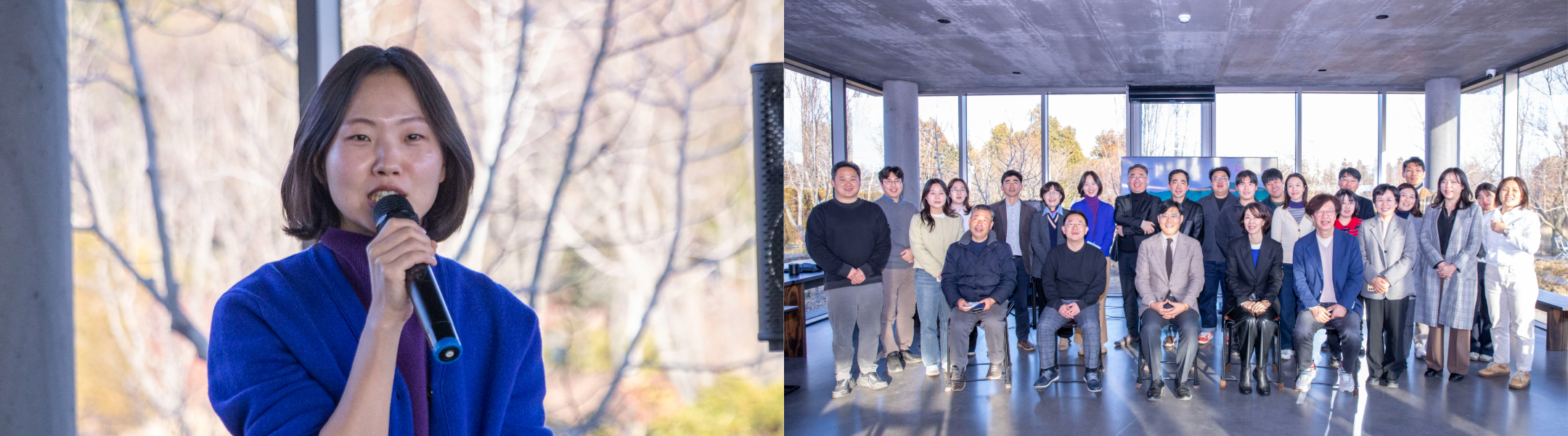
Building on this momentum, the “Jeju Garden City Talk” served as a platform to refocus policy discussions on local, on-site realities. The central question was: “Garden City—what should we restore, rather than what should we add?” While Jeju has long been consumed as a ‘tourist paradise,’ it has now become the front line of the climate crisis. In this context, a garden is no longer about decorating landscapes with flowers; it is redefined as a ‘living foundation’ for enduring climate disasters.
When we perceive the climate crisis as ‘slowly rising water,’ our response must be a long-term structural transformation.
Climate change does not strike everyone at the same speed or magnitude; the most vulnerable are the first to suffer. Therefore, adaptation is not merely a technical issue but a “social mechanism for maintaining daily life,” which must be implemented locally.
Gardens, urban forests, and green spaces are central to this mechanism—cooling summer heat, mitigating floods by capturing rainwater, providing biodiversity refuges, and supporting the mental recovery of citizens.
The focus of the presentations and discussions in Jeju was on three specific strategies for restoration:
“Jeju-ness” (Identity): Natural conditions such as basalt, spring water, volcanic ash soil, wind, and strong sunlight are assets for garden design. A Jeju-style garden should be a ‘supporting actor’ that enhances the visibility of the surrounding natural space rather than being ostentatious. A naturalistic approach—removing artificial decorations and restoring habitats suited to Jeju’s climate—forms the base.
The “Subtraction” Strategy: Jeju teaches that sometimes, less is more. Instead of expanding infrastructure or pursuing uniform development, preserving and restoring existing landscapes can become a source of competitiveness for the city.
Vision of “Natural Civilization”: When gardens are treated as platforms connecting carbon neutrality, adaptation, tourism, education, and industry, Jeju’s model becomes an experiment for a new civilization where nature and humans coexist. This involves a ‘dual strategy’: expanding green spaces in daily urban life (school gardens, environmental gardens) while maximizing the value of pristine nature in wilder areas.
From Declaration to Practice: The System of a Garden City
A garden city is not completed by declaration alone. Currently, gardens, parks, and forests fall under different legal systems and management bodies, with fragmented budgets and goals. Unless urban planning, ecological restoration, and climate policy are integrated into a single spatial framework, even the most plausible plans will scatter in the field. To bridge this gap, two things are necessary:
1. Reality in Law, System, and Budget
In the field, the grounds for garden design, procurement, and management are often unclear. We need a system where education, practice, qualifications, and data form a virtuous cycle. Accumulated data—on how much a garden absorbs, which species fit the local climate, and the actual effects of management costs—is essential for policy to mature over time.
2. An Organized Structure for Civic Participation
Garden cities cannot be sustained without broad citizen participation—often cited as 60–70%. Yet, this is difficult for administrative bodies to lead alone. The solution lies in Public-Private Partnerships. Local NGOs, regional councils, and private experts must collaborate from the planning stage to build a culture of participation over 3 to 5 years. Examples from cities such as Jinju, Pyeongtaek, and Osan demonstrate that governance models integrating administrative leadership with private expertise and civic participation are key to long-term sustainability.
Regarding human resources, we need to cultivate “Global Gardeners”—specialists who understand local ecology and can manage vegetation to expand indigenous plants to a global scale. If a garden becomes a platform for regional identity and economy, the capacity of the people operating that platform will ultimately determine the success of the policy.
Conclusion
A Garden City is not a ‘declaration’ but a ‘practice.’ And the condition for that practice lies in changing the entire system of the city, not just a single garden plot. The 2nd Garden City Seminar in the Era of Climate Adaptation, to be held in Seoul on April 30, aims to integrate these field concerns and seek concrete spatial strategies through ‘Green Infrastructure City Cases.’
Global Gardener: A concept proposed by "Jogyeong-hada Yeoreum," referring to professionals who deeply understand local climate and ecology to design and operate the sustainability of a garden city—connecting habitat restoration, management, education, and branding.


-
[동정] 최재철 기후변화센터 이사장, 동국대 120주년 기념 명사 특강 강연
목록
-
[Carbon Market Trends Brief] Will the Expansion of Seagrass Blue Carbon in Korea Emerge as a New Supply Source for VCM?


