

[Activity] CHOI Jai-chul, Chairman of the Climate Change Center, Presents Regional Cooperation–Based Climate Leadership at the 2025 East Asia Climate Dialogue
본문
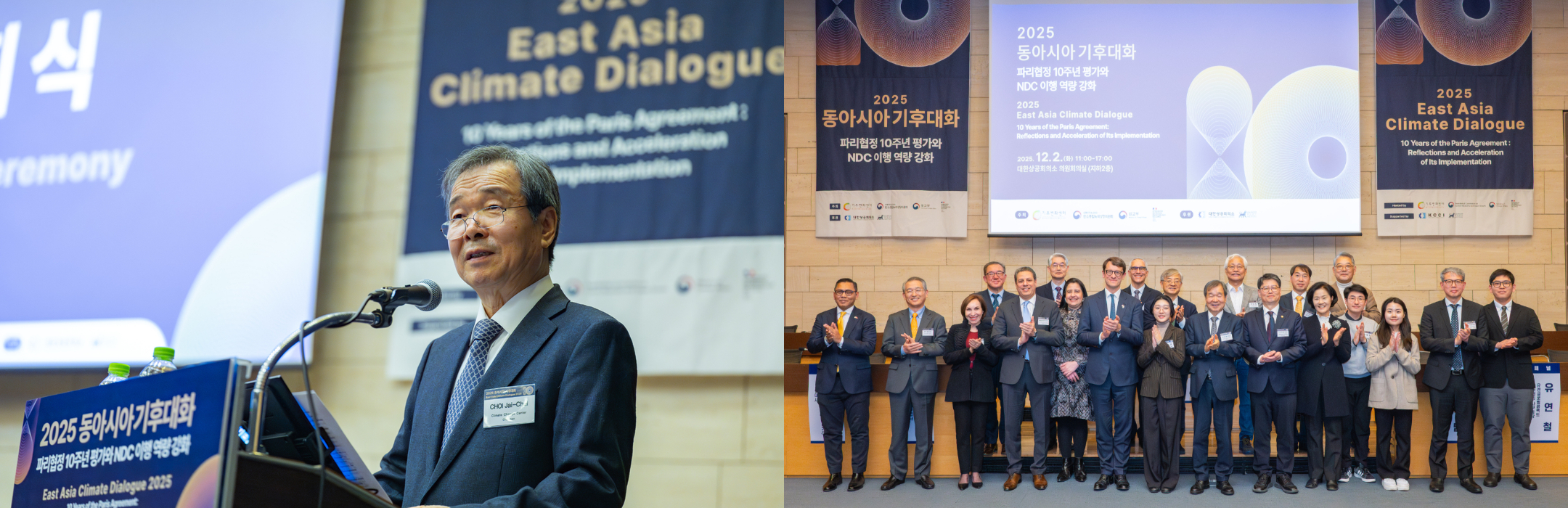
On December 2, the Climate Change Center, together with the Presidential Commission on Carbon Neutrality and Green Growth, the Ministry of Foreign Affairs, and the Embassy of France to the Republic of Korea, hosted the “2025 East Asia Climate Dialogue” at the Council Chamber of the Korea Chamber of Commerce and Industry.
At the opening ceremony, CHOI Jai-chul characterized the day’s discussions as “a turning point for climate leadership connecting Paris, Belém, and Seoul,” presenting a vision for building a cooperative implementation framework across the East Asian region.
Drawing on his experience as Korea’s chief negotiator for the Paris Agreement, Chairman CHOI underscored that East Asia—now both the center of global emissions and the critical testbed for mitigation—must advance a strengthened regional response. He stated that “in the era of the 2035 NDC, implementation must be driven not only by central governments but by local governments, industry, civil society, and youth alike.”
Chairman CHOI also highlighted that this year’s forum marks the first session of the “East Asia Climate Dialogue (EACD),” announcing plans to expand the platform next year to include all ten ASEAN countries and to institutionalize a Seoul-centered regional cooperation framework.
He further emphasized that extending the legacy of the Paris Agreement’s first decade into regional solidarity and practical action is the defining task of the next ten years, affirming the Center’s commitment to strengthening its role as an implementation hub that connects policy, diplomacy, industry, local actors, and youth.


-
[Activity] Chairman Choi Presents Strategic Insights on Climate and Energy Transition at the 2025 Autumn Conference of the Korea Society of Climate Change Research
List
-
[Activity] CHOI Jai-chul, Chairman of the Climate Change Center, Highlights Blue Carbon’s NDC Contribution Potential at the International Sea Forest Forum


