

[Field Sketch] The 8th TALK_TALK! Carbon Neutrality: Resource Circulation & Green Jobs
2025-10-28
본문
The 8th TALK_TALK! Carbon Neutrality: Resource Circulation & Green Jobs

On October 28, the 8th TALK_TALK! Carbon Neutrality was held under the theme of “Resource Circulation and Green Jobs.”
The event brought together future generations and experts to reflect on the meaning of work and explore new pathways toward a carbon-neutral society.
Hosted by the Climate Change Center, the event gathered experts and young participants from various sectors to discuss the interconnection between a sustainable economy and green employment.
‘TALK_TALK! Carbon Neutrality‘ is a public dialogue platform where future generations and experts select key carbon neutrality issues that require social consensus. Based on scientific approaches and rational discussions, the program fosters understanding and builds common ground through open, interactive conversations.
■ Expanding Resource Circulation into the Language of Industry
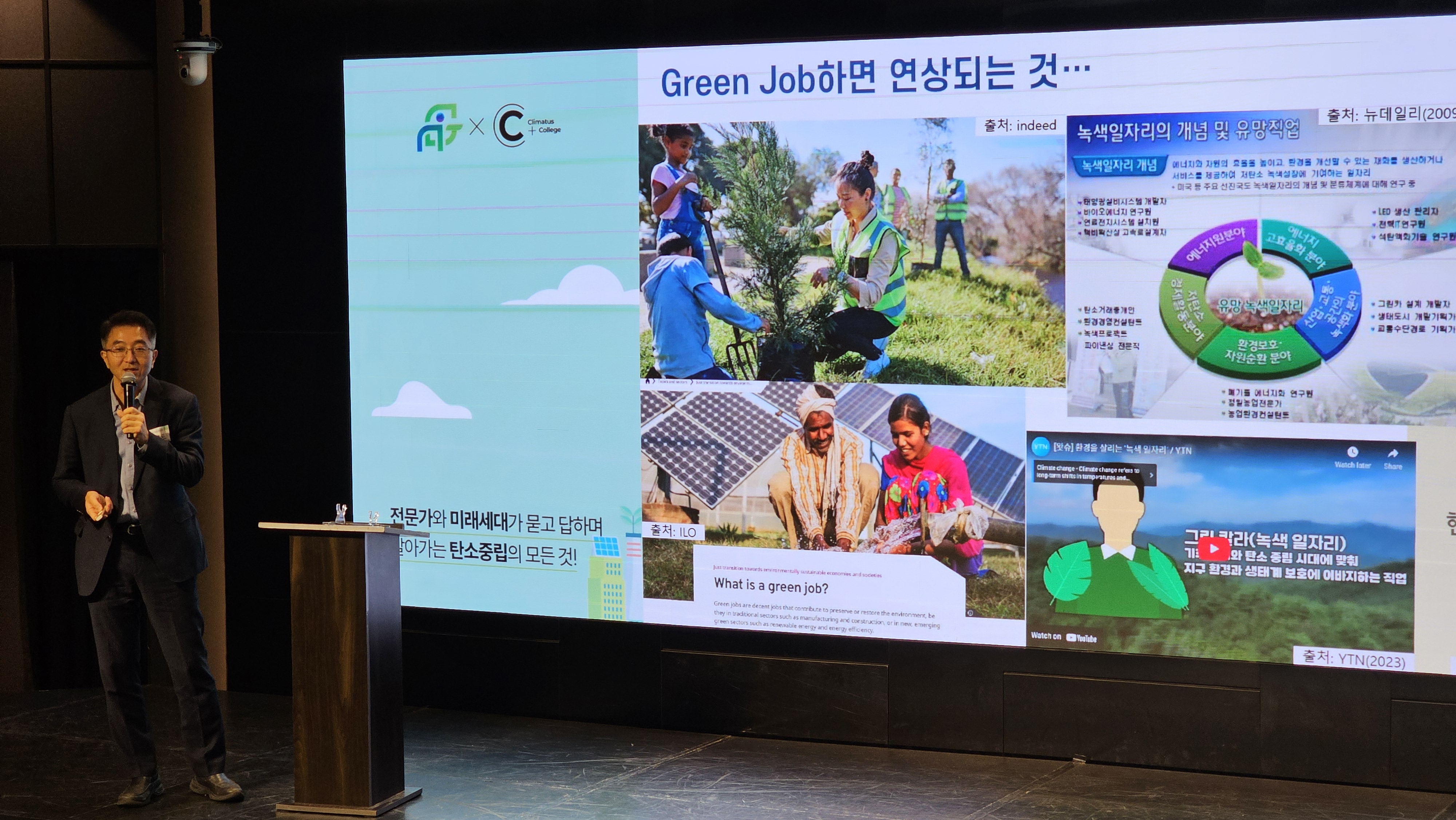
Taegun Kim, Senior Researcher at the National Institue of Green Technology(NIGT), opened the session with the question, “What are green jobs?”
He introduced the 4R×CEI job matrix, which combines the four core principles of resource circulation — Reduce, Reuse, Recycle, and Recovery (4R) — with the industrial value chain components Core, Enabling, and Indirect (CEI), presenting a structured approach to understanding green job potential within the resource circulation sector.
He also pointed out that Korea’s industrial landscape remains heavily concentrated in reduction and recycling, emphasizing the need for sector-specific workforce development and targeted policy support.

Professor Dongyeob Oh of Korea University’s School of Materials Science and Engineering highlighted cases such as the EU Carbon Border Adjustment Mechanism (CBAM) and strengthened recycling obligations, noting that the eco-friendly transition has become a core driver of industrial competitiveness.
He further stressed the growing importance of Life Cycle Assessment (LCA)—quantifying carbon emissions from a product’s production to disposal—and noted that technological innovations, including AI-based waste-plastic sorting, have the potential to create entirely new categories of green jobs.
■ The Industry of Relationships : Resource Circulation
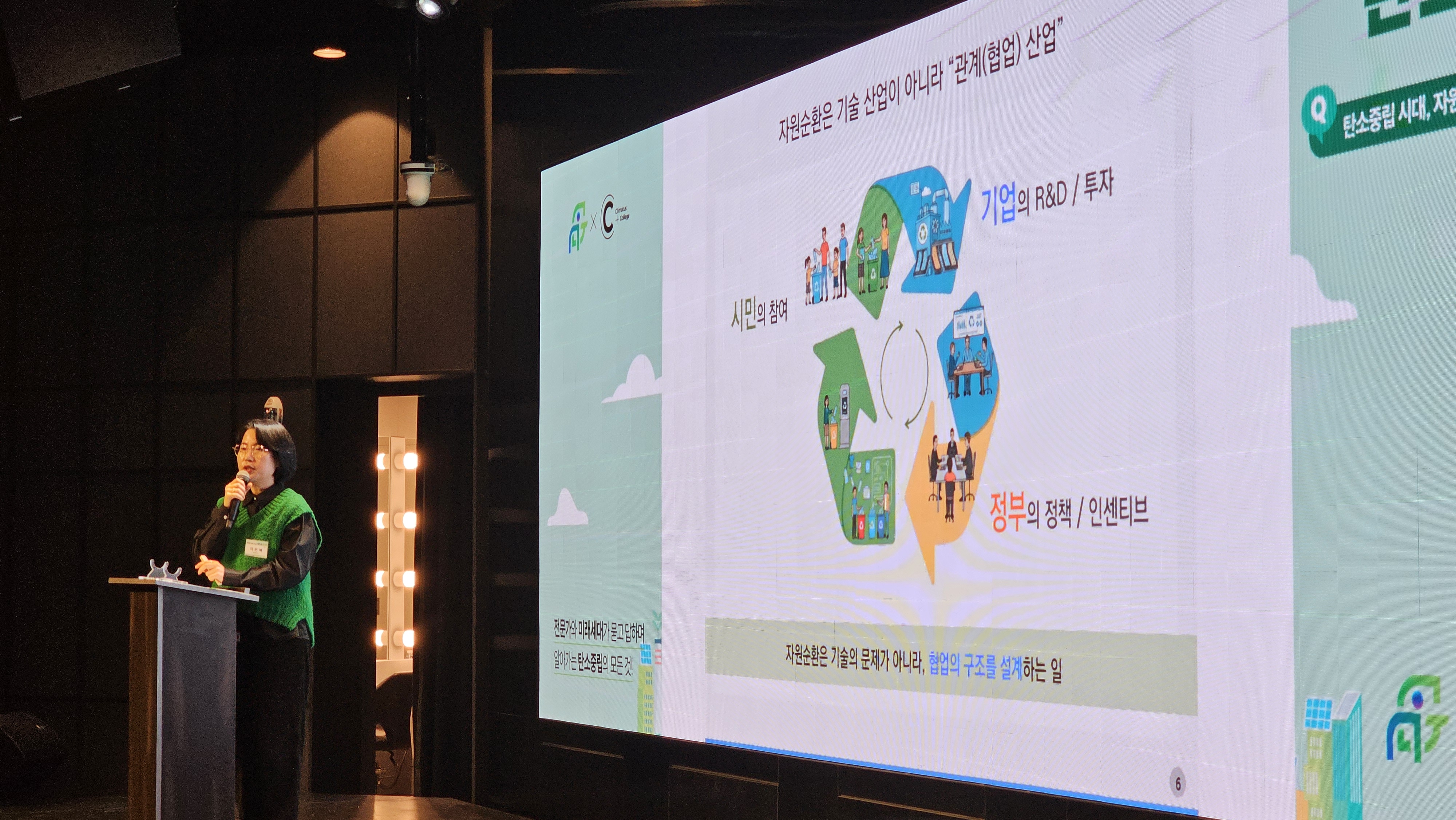
Environmental innovator Eun-ae Lee, active as a Loop Builder, shared the case of Project Loop, a collaborative initiative created by businesses, citizens, and government. She emphasized that
“Resource circulation is not a technology industry — it is an industry of relationships.”
She introduced three career “loops” that shape the resource circulation ecosystem:
1. Technology Loop – Circular technologies such as chemical recycling
2. Design Loop – Designers and planners who create products that are easy to repair and recycle
3. Social Loop – Experts in ESG, policy, and campaigns who transform systems and public perception
She noted that “resource circulation is not about creating new jobs, but about redefining existing ones through a new perspective,” encouraging participants to find their own roles within the circular loop using their fields of study and strengths.

■ Saving the Environment with Waste — Climate Tech and Sustainability
Seungchan Yang, CEO of STARSTECH, presented the case of developing an eco-friendly deicer made from upcycled starfish, a marine waste resource.
He emphasized that “the environment can indeed be economically viable,” introducing a climate-tech business model that reduces road damage and maintenance costs while demonstrating measurable carbon-reduction benefits.
In particular, he highlighted the company’s achievement of becoming the world’s only deicer manufacturer to receive carbon-credit certification, made possible by quantifying the product’s carbon-reduction impact through Life Cycle Assessment (LCA).
Under the vision of “saving the environment with waste,” he showcased the tangible potential of the resource-circulation industry.
■ Exploring the Future of Green Jobs Through Diverse Questions
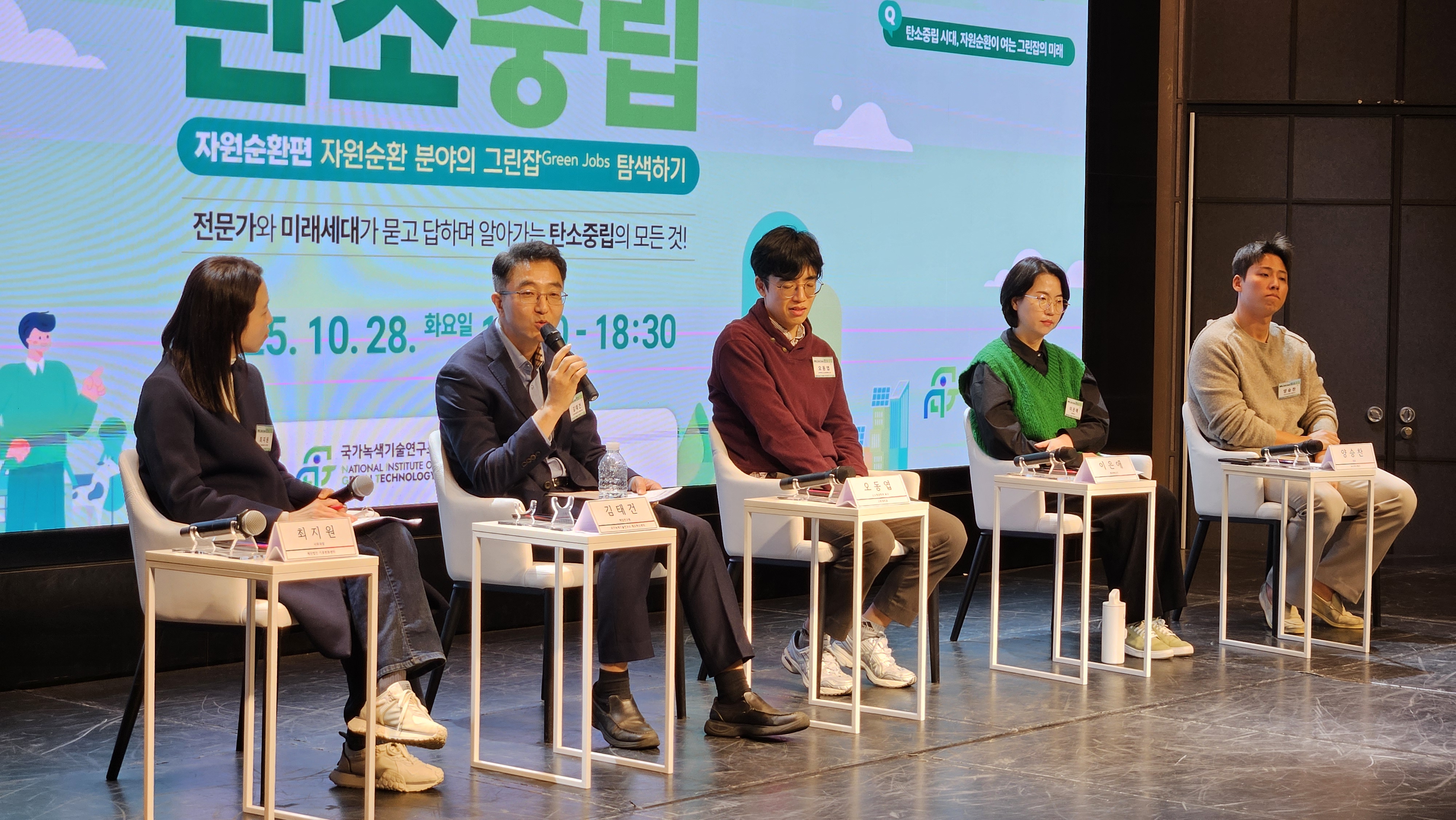
Throughout the session, participants raised practical questions such as “Can green jobs really be profitable?”, “Can AI and resource circulation coexist?”, and “Can non-majors work in research institutes?”
Real-time questions and comments from online participants also flowed in, creating an open forum rich with diverse perspectives.
Responding to the coexistence of AI and resource circulation, **Professor Oh** remarked,
“Even if AI replaces repetitive tasks, the human role in designing problems will become even more important.”
Regarding the job ecosystem and required skills in the resource circulation industry, Senior Researcher Taegun Kim explained that “according to the 4R×CEI job matrix, small and startup companies are heavily concentrated in reuse and recycling, while fields like recovery—which require large-scale facilities—remain relatively limited,” emphasizing the need for sector-specific workforce development and targeted policy support.
Environmental innovator Eun-ae Lee added that “the resource circulation industry grows when systems and markets operate together,” highlighting the importance of understanding system design—including laws, incentives, and collection systems—as a core competency for industry growth.
When asked whether green jobs can become sustainable long-term careers, CEO Seungchan Yang stressed the importance of sensing policy timing, noting that staying attuned to the flow of policies, regulations, support systems, and incentives is just as critical as technological expertise.
The panelists agreed that ESG and resource circulation are inherently interdisciplinary fields, integrating law, society, management, design, and engineering—meaning that diverse academic backgrounds and experiences can serve as strengths rather than limitations in pursuing green-job careers.

A Shift in Perception — From “Environmental Practice” to “Economic Innovation”
In a pre-event poll asking, “Are resource circulation and green jobs environmental practices or economic innovations?” the responses were nearly split: 46% environmental practice and 54% economic innovation.
However, after the talk, the share of participants choosing “economic innovation” rose sharply to 79%, indicating that young people increasingly view green jobs not merely as environmental actions but as a driving force for industrial transformation.
The 8th TALK_TALK! Carbon Neutrality: Resource Circulation & Green Jobs brought together perspectives from technology, industry, policy, and youth to envision the future of sustainable work.
From plastic waste to eco-friendly deicers, and from corporate field cases to policy research, the discussions converged on a clear message
Addressing the climate crisis is not just a responsibility—it is a new opportunity for work.
Climatus College will continue to create spaces for learning and experimentation, enabling young people to discover and connect their roles within the circular economy.


-
기후위기를 ‘나의 일’로, 자원순환으로 청년의 미래를 그리다
목록
-
자원순환의 시대, 일의 정의를 다시 쓰다 - 제8회 톡톡_Talk, Talk! 탄소중립 : 자원순환&그린잡


