

[On-Site RE:VIEW] Climate Change Center Newsletter | Garden Cities: A New Paradigm for Climate Adaptation
2025-09-30
본문
The 1st Seminar on Garden Cities in the Era of Climate Crisis
“Cooling Cities with Gardens, Designing the Future of Climate Resilience”
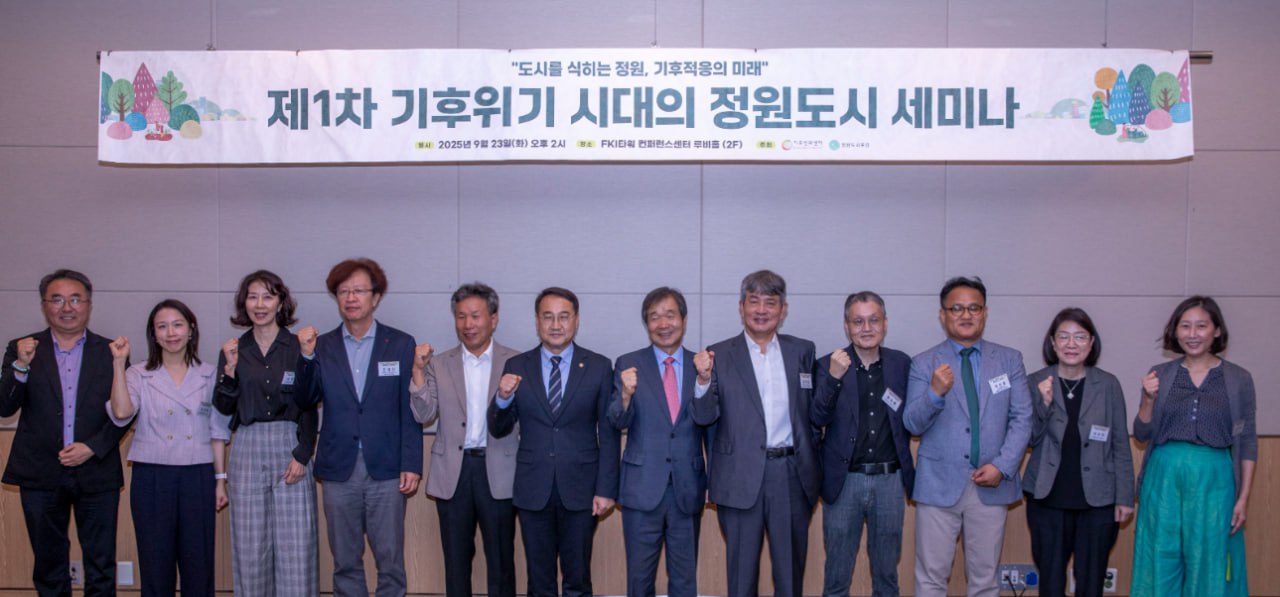
In the Era of Climate Crisis, A New Urban Survival Strategy
As the climate crisis intensifies, threats such as extreme heat, flooding, and deteriorating air quality are no longer exceptional events but everyday risks. At the same time, unchecked urbanization and ecological degradation have become major barriers to building resilient cities. Against this backdrop, gardens and urban forests are being redefined not as mere landscaping, but as core infrastructure for climate adaptation and vital socio-ecological safety nets.
With this shared sense of urgency, the Climate Change Center (CCC) and the Garden City Forum co-hosted the First Symposium on Garden Cities in the Era of Climate Crisis on September 23. Under the theme “Cooling Cities with Gardens: The Future of Climate Adaptation”, the symposium reviewed international trends and domestic legal and policy challenges, while exploring the direction of a Korean-style Garden City model.
■ Opening and Welcome Remarks
In his opening address, Chairman Jai-chul Choi of the Climate Change Center stressed that “climate adaptation is no longer a matter of choice but of survival, and gardens and urban forests are the foundations that enhance community resilience and underpin a carbon-neutral society.” He further noted that adaptation and resilience are rapidly becoming central issues in international cooperation, signaling that the Garden City discourse will extend beyond Korea into the global arena.
Kim In-ho, Director-General of the Korea Forest Service, emphasized in his congratulatory remarks that the convergence of gardens and climate adaptation could provide new solutions to social challenges. He also highlighted that while Garden Cities are growing in national importance, they still lack legal and institutional foundations—something the Korea Forest Service intends to address through new frameworks and policy reforms.
■ From Mitigation to Adaptation: A Policy Shift
Dr. Chang-seop Kim, Policy Chair of CCC and Professor at Gachon University, called for a transition from a mitigation-focused policy framework to one centered on adaptation. Citing the nation’s historical reforestation campaigns as an example of transformative social change, he urged the Korea Forest Service to take the lead—together with local governments—in promoting Garden Cities and urban forest projects as key pillars of adaptation policy.
■ Presentation 1 – Garden Cities as a Korean Urban Model
Professor Kyung-jin Cho of Seoul National University and Chair of the Garden City Forum argued that Garden Cities can evolve into a distinct Korean urban model, contributing not only to climate adaptation but also to countering rural decline and reviving local communities. He cautioned against uniform, construction-heavy projects and pointed to the need for a software-oriented approach—centered on culture, community, small-scale green spaces, and citizen participation.
■ Presentation 2 – Data and Accessibility as Key Drivers
Dr. Chan-ryeol Park, Center Director at the National Institute of Forest Science, identified data and accessibility as the cornerstones of future urban forest strategies. He stressed that expanding the area of urban forests is not enough; instead, it is crucial to build green networks easily accessible to all citizens. He also highlighted the importance of data-driven management systems and private-sector engagement in sustaining urban greening efforts.
■ Presentation 3 – Lessons from the UK’s Biodiversity Net Gain
Dr. Eun-hye Kim of the University of Nottingham presented the UK’s Biodiversity Net Gain (BNG) policy, which requires all development projects to increase biodiversity by at least 10%. This is supported through mechanisms such as credit purchases and habitat restoration programs. She emphasized that Korea could draw valuable lessons from such international models when institutionalizing its Garden City framework.
■ Presentation 4 – The Need for Legal and Financial Foundations
Professor Seung-heum Hwang of Kookmin University pointed out the lack of concrete goals and enforcement mechanisms in Korea’s adaptation policies. He stressed that robust legal and financial frameworks from the central government are essential to advance Garden Cities. He also called for resolving overlapping ministerial roles, dismantling institutional barriers, and prioritizing green expansion projects that deliver tangible benefits to citizens.
■ Panel Discussion – Gardens as Everyday Infrastructure
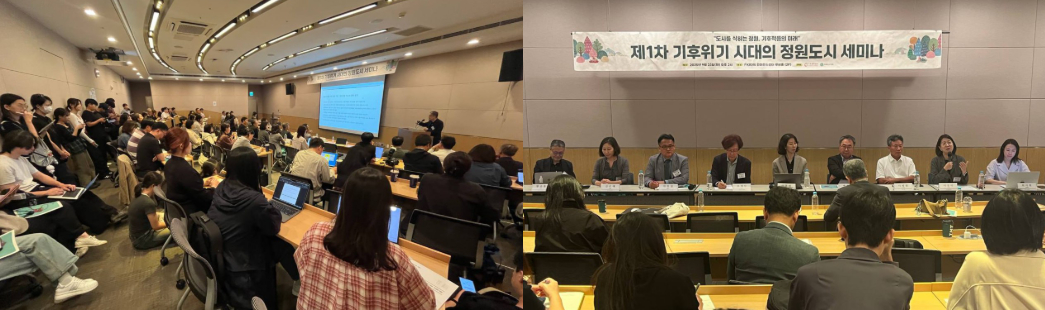
The panel discussion, chaired by Young-ae Seo of I-Soo Engineering, brought together experts including Joon-gyu Bae (Korea National Arboretum), Byung-chul Lee (BS Group), Yu-mi Lee (Korea National University of Cultural Heritage), and Ji-won Choi (CCC Secretary-General).
Panelists agreed that gardens and urban forests must be reframed as core urban infrastructure, not temporary or showcase projects. They highlighted the need for legal and institutional reforms, monitoring and feedback systems, use of native plants, integration of local ecological and cultural assets, and inclusive policies that account for vulnerable groups. Above all, they advocated building decentralized green networks accessible within 15–30 minutes of daily life, thereby establishing citizen-centered, carbon-neutral urban models.
■ Toward a New Urban Paradigm
The symposium redefined gardens and urban forests as essential infrastructure for climate adaptation, moving them beyond the realm of ornamental landscaping. By linking them with law, finance, governance, and citizen participation, it presented concrete strategies to elevate the Garden City model into both a national and international agenda.
The Climate Change Center concluded that this symposium marked the beginning of a new paradigm in urban policy for the climate crisis era. Moving forward, it plans to expand cooperation with local governments, civil society, and the private sector, with the goal of developing a Korean Garden City model that can serve as a globally relevant template for climate adaptation.


-
[공지] (재)기후변화센터 창립 제17주년 후원 감사의 밤 초청(10.23.(목), 앰배서더 서울 풀만 호텔)
목록
-
[CC Cloumn] Climate and Biodiversity: An Inseparable Dual Crisis


