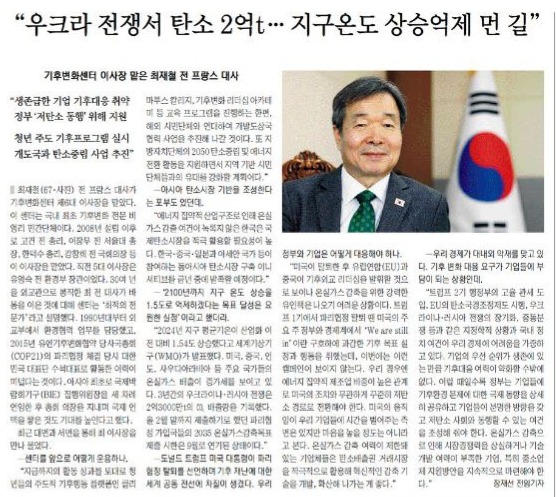
[Interview] “200 Million Tons of CO₂ Emitted in Ukraine War Alone… 1.5°C Climate Target Now Out of Reach”
본문
Ambassador Choi Jai-chul, Newly Appointed Chair of the Climate Change Center, Calls for Bold Climate Action and Institutional Support
Choi Jai-chul (67), former Ambassador of South Korea to France, has been appointed as the 6th Chair of the Climate Change Center, Korea’s first non-profit NGO dedicated exclusively to climate change. Since its founding in 2008, the Center has been led by a succession of high-profile figures including former Prime Minister Goh Kun, former Seoul National University President Lee Jang-moo, current Prime Minister Han Duck-soo, and former National Assembly Speaker Kang Chang-hee. His predecessor was Yoon Yeo-sook, former Minister of Environment.
The Center described Ambassador Choi as the “ideal expert” for the role, citing his extensive diplomatic career and environmental credentials. In the 1990s, he oversaw international environmental cooperation at the Ministry of Foreign Affairs, and later led the Korean delegation to the landmark COP21 in Paris in 2015, where the Paris Agreement was adopted. He also served three consecutive terms as Chair of the Executive Committee of the Bureau International des Expositions (BIE), strengthening his global network. Now, he takes the helm amid mounting global challenges, including the U.S. withdrawal from the Paris Agreement and worsening economic and environmental crises.
In a recent conversation, Ambassador Choi shared his outlook and vision for the Center.
Q. What direction will you take the Climate Change Center in?
"Building on the Center’s existing programs, we will expand educational initiatives such as the Climatus College platform for youth-led climate action and the Climate Leadership Academy. At the same time, we aim to collaborate with international civil society to promote development cooperation projects in emerging economies. Another key priority is supporting local governments’ 2050 carbon neutrality efforts and strengthening networks with regional environmental NGOs."
Q. You’ve mentioned ambitions to establish a carbon market framework in East Asia.
"Given Korea’s energy-intensive industrial structure, it is imperative that we engage actively with the international carbon market. We are preparing to launch an East Asia Carbon Market Initiative later this year, bringing together Korea, China, Japan, and ASEAN countries."
Q. In your welcome message on the Center’s website, you wrote that keeping global warming below 1.5°C by 2100 is becoming increasingly unlikely.
"According to the World Meteorological Organization, the global average temperature in 2024 has already risen 1.54°C above pre-industrial levels. Major emitters such as the U.S., China, Russia, India, Saudi Arabia, and South Africa continue to increase emissions. Over the past three years, the war in Ukraine alone has resulted in an estimated 230 million tons of CO₂ emissions. The deadline for countries to submit their updated 2035 Nationally Determined Contributions (NDC 3.0), originally set for February, has been extended to September."
Q. How should Korea respond to the U.S. withdrawal from the Paris Agreement under President Trump’s second term?
"While the EU and China may seek to fill the diplomatic leadership gap, strong incentives for emissions reductions are unlikely in the current geopolitical climate. During Trump’s first term, we saw a ‘We Are Still In’ movement by U.S. states and businesses. That kind of mobilization seems absent this time. For Korea, regardless of U.S. policy, we must stay on track with our low-carbon transition, especially given our reliance on manufacturing. The U.S. stance may buy our companies some time, but it should not be a reason to relax. Companies with limited abatement capacity should make strategic use of emissions trading markets to scale up innovative mitigation technologies."
Q. Korean businesses are already under pressure due to global and domestic challenges. Isn’t climate action an added burden?
"The Trump administration’s high tariffs, the EU’s Carbon Border Adjustment Mechanism, the prolonged Ukraine war, and ongoing conflicts in the Middle East—all compounded by domestic political instability—are straining Korea’s economy. Many companies are focused on survival, which weakens their ability to respond to climate demands. That’s why the government must proactively communicate global climate trends and help businesses align with the transition to a low-carbon economy. Special support should be provided to SMEs and companies facing competitiveness or technological capacity gaps due to emission reductions."
Q. Are there any local governments in Korea that are leading the way in climate action?
"Many local governments have been actively involved since the 1990s. In particular, cities in the ‘Local Governments for Climate Crisis Response and Energy Transition’ network have developed strategies tailored to their regional contexts. Examples include Jeju’s ‘Carbon-Free Island’ initiative, the renewable energy expansion strategies of South and North Jeolla Provinces, and South Chungcheong Province’s roadmap for low-carbon energy transition."
Copyright © Munhwa Ilbo. All rights reserved.