

[Commentary] Global Climate Cooperation at a Crossroads: A Time for Reflection and Renewal
본문
On January 20, 2025, Donald J. Trump was inaugurated as the 47th President of the United States. Due to a severe Arctic cold front, the ceremony was held indoors at the Capitol rather than outdoors. On his first day in office, President Trump announced the U.S. withdrawal from the Paris Agreement and declared a national energy emergency—decisions aligned with his campaign slogan “Make America Great Again (MAGA).”
The year 2024 was recorded as the hottest year since the Industrial Revolution, marked by increasingly frequent and intense climate disasters including droughts, floods, and storms worldwide. Just days after President Trump’s inauguration, wildfires in Los Angeles, California destroyed over 17,000 homes and resulted in more than 80 casualties and missing persons, with damages exceeding 4 trillion KRW. While some had hoped for a shift in Trump’s climate policy during his second term, those hopes were quickly eclipsed by a flurry of executive orders signed on Inauguration Day.
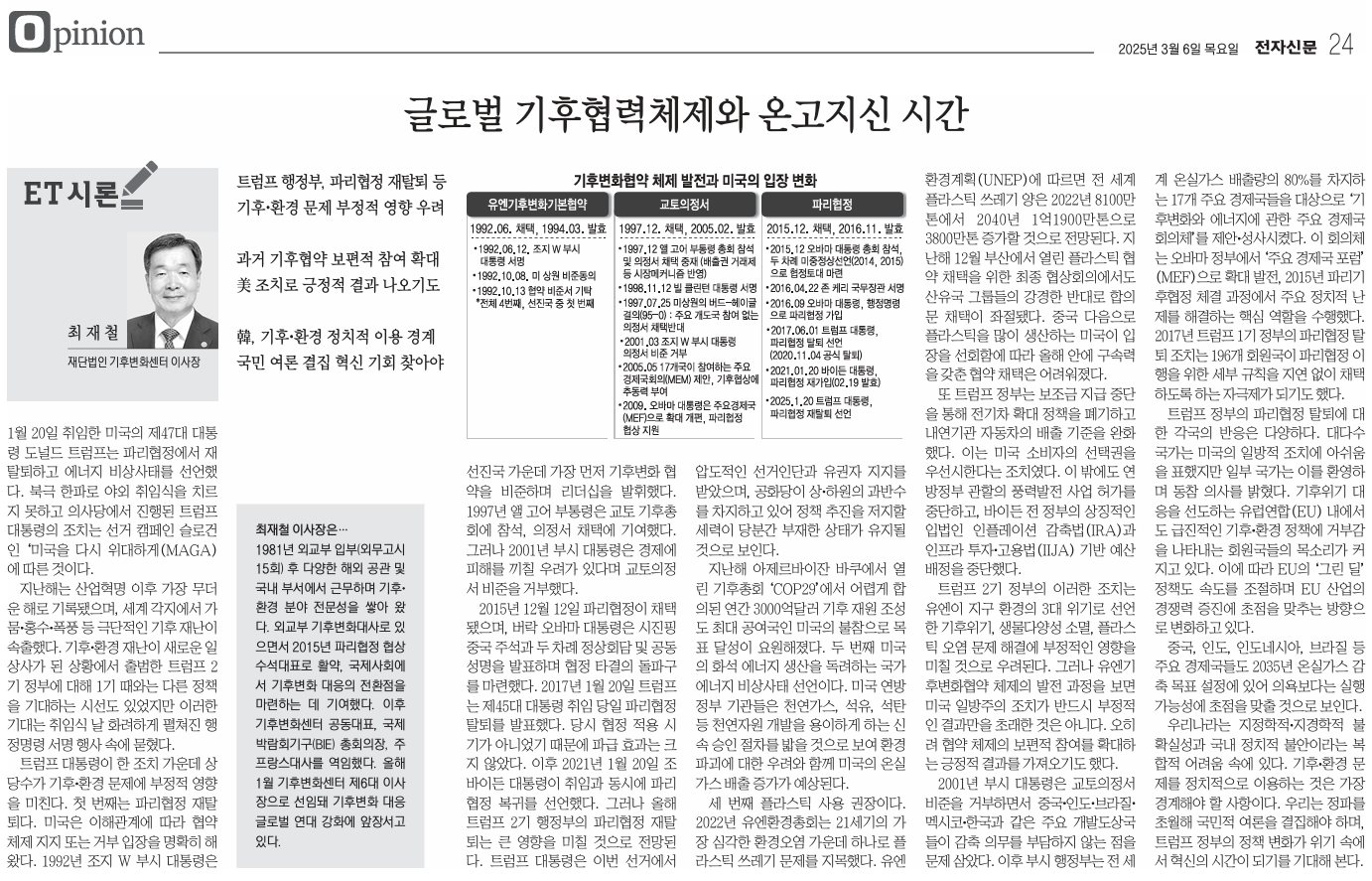
Many of the administration’s early measures are likely to have detrimental effects on global climate and environmental efforts. The first of these is the withdrawal from the Paris Agreement. Historically, U.S. positions on international climate agreements have shifted depending on the administration. President George H.W. Bush ratified the UN Framework Convention on Climate Change in 1992, demonstrating leadership among developed nations. In 1997, Vice President Al Gore played a key role in the adoption of the Kyoto Protocol. However, in 2001, President George W. Bush rejected ratification, citing potential economic harm to the U.S.
In contrast, President Obama played a pivotal role in finalizing the Paris Agreement in December 2015, working closely with Chinese President Xi Jinping. While Trump announced withdrawal from the Paris Agreement on the day of his first inauguration in 2017, the actual impact was limited due to the agreement’s timeline. In 2021, President Biden rejoined the accord on his first day in office. But the 2025 withdrawal, backed by overwhelming electoral support and Republican control of both chambers of Congress, is expected to have far more serious and lasting implications.
One immediate consequence has been the unraveling of the $300 billion annual climate finance goal agreed at COP29 in Baku last year, as the U.S., the largest contributor, withdraws its support. In addition, Trump’s declaration of a national energy emergency has expedited federal approvals for fossil fuel projects, raising concerns about environmental degradation and increased greenhouse gas emissions.
Another troubling move is the administration’s promotion of plastic use. At the 2022 UN Environment Assembly, plastic pollution was labeled one of the most critical environmental crises of the 21st century. UNEP projects global plastic waste to rise from 81 million tons in 2022 to 119 million tons by 2040. At the final round of negotiations for a global plastic treaty held in Busan in December 2024, disagreements among oil-producing countries—led in part by a reversal from the U.S.—prevented the adoption of a binding agreement.
The administration has also rolled back EV incentives and relaxed emissions standards for internal combustion engine vehicles, citing consumer freedom. Furthermore, it suspended offshore wind permits and halted budget allocations under hallmark legislation like the Inflation Reduction Act (IRA) and the Infrastructure Investment and Jobs Act (IIJA). USAID and the EPA have faced drastic funding and functional reductions.
These policy shifts are expected to undermine global efforts to address the UN-designated "Triple Planetary Crisis": climate change, biodiversity loss, and plastic pollution. However, history shows that U.S. unilateralism has not always had entirely negative consequences for international climate governance. In some cases, it has catalyzed broader multilateral action.
For instance, when President George W. Bush rejected the Kyoto Protocol in 2001, he criticized the exemption of major emerging economies like China, India, Brazil, and South Korea. His administration then initiated the “Major Economies Meeting on Energy Security and Climate Change,” which eventually evolved into the Major Economies Forum (MEF) under President Obama—a key platform that helped resolve political deadlocks leading to the Paris Agreement. Similarly, Trump’s 2017 withdrawal arguably accelerated rule-making under the Paris Agreement among its 196 Parties. With the U.S. now stepping back once again, the world awaits whether Trump will propose an alternative framework.
Global reactions to the U.S. withdrawal have been mixed. While most countries expressed regret, some welcomed the decision. Even within the EU—traditionally a leader in climate action—opposition to overly ambitious green policies is growing among certain member states, prompting a shift in the European Green Deal toward industrial competitiveness.
Major emerging economies such as China, India, Indonesia, and Brazil are also expected to prioritize feasibility over ambition in setting their 2035 climate targets. These countries may scale back the pace of renewable energy expansion, electric vehicle adoption, and decarbonization of industry and power sectors.
Meanwhile, South Korea finds itself in a uniquely complex position, grappling with geopolitical and geo-economic uncertainty as well as domestic political instability. Now more than ever, it is critical to keep climate and environmental issues above political interests. What Korea needs is a broad, bipartisan national consensus—and a willingness to turn this global uncertainty into an opportunity for bold innovation and transformation.
Copyright © Electric Times. All rights reserved.


